
Artificial intelligence is already changing title and escrow operations, but the useful conversation is narrower than the hype. The question is not whether a machine can “do title.” The question is which repetitive, data-heavy and time-sensitive tasks technology can perform better so experienced professionals can spend more time on judgment, exceptions and clients.
That is the practical promise of AI title insurance. Used well, it can compress administrative work, improve visibility and help a title operation handle more volume without lowering its standards. Used carelessly, it can accelerate the wrong answer, expose confidential information and create a record no one can explain.
The difference is governance.
Title Work Contains Both Rules and Judgment
Title production includes many structured activities: receiving an order, extracting information, locating documents, classifying records, assigning tasks, checking fields and communicating status. Those activities are strong candidates for automation because the inputs, outputs and expected controls can be defined.
Other activities require professional interpretation. An examiner may need to decide whether two names refer to the same person, how an instrument affects the estate being insured, whether an exception can be removed or what evidence satisfies an underwriting requirement. Those decisions depend on the record, applicable law, underwriting guidelines and transaction context.
A sound AI title insurance strategy respects that division. Technology prepares, organizes, compares and flags. Authorized professionals evaluate, decide and remain accountable.
High-Value Uses of AI in Title Operations
The best early use cases are not theatrical. They remove small delays repeated across thousands of files.
Order Intake and Data Extraction
AI-assisted tools can read incoming emails and documents, identify relevant fields and place information into a structured workflow. The system can flag missing borrower names, inconsistent property addresses or absent purchase contracts for review. This reduces rekeying and helps the team start with a cleaner order.
Document Classification
Search packages can contain deeds, mortgages, releases, assignments, judgments, tax records and other instruments. Technology can classify and organize those documents so examiners reach relevant evidence faster. The classification should be reviewable, and uncertain results should be routed to a person rather than silently accepted.
Task Routing and Prioritization
An AI-assisted workflow can help route files by state, product, complexity, closing date or exception type. It can identify aging work and surface transactions that require attention. This is especially valuable for multistate operations, where one generic queue can hide meaningful jurisdictional differences.
Communication Support
Systems can summarize file activity, propose status updates and draft routine messages. The efficiency gain is real, but outbound communication still needs controls. A draft that misstates a requirement or implies a guaranteed closing can damage the transaction even if it was produced quickly.
Quality-Control Flags
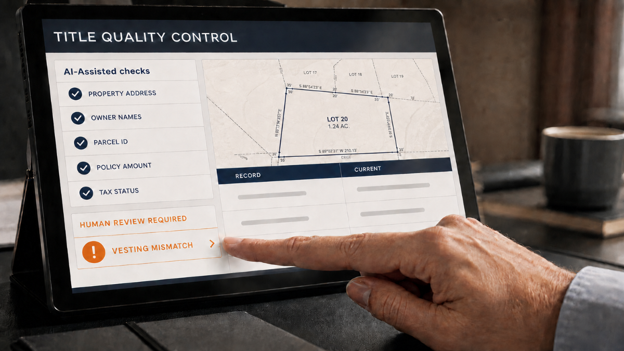
Technology can compare names, property data, policy amounts, vesting and other fields across source documents and the commitment draft. It can identify inconsistencies for human review. That makes AI title insurance valuable as a second set of eyes, provided the system is treated as a detection tool rather than an infallible reviewer.
What AI Should Not Be Allowed to Decide Alone
Automation should not independently make underwriting decisions, provide legal advice, clear material exceptions or represent uncertain facts as established. It should not send wire instructions without the organization’s required verification controls. It should not place sensitive transaction data into an unapproved public model.
The operational boundary should be explicit. Every use case needs an owner, a defined input, an approved output, a confidence threshold and an escalation path. If no one can answer who reviews an uncertain result, the workflow is not ready for production.
The Risk Controls That Matter
Title companies hold financial, personal and property information. AI adoption must therefore be part of the organization’s broader information-security, privacy, vendor-management and business-continuity program.
Data Access and Confidentiality
Teams should know what information enters a model, where it is processed, how long it is retained and whether it can be used to train another system. Access should follow job responsibilities, and sensitive data should not be copied into consumer tools merely because they are convenient.
Auditability
A title operation should be able to reconstruct what the system received, what it produced, who reviewed it and what action followed. Audit trails matter when a result is challenged, a process changes or an error must be traced to its source.
Accuracy Testing
Models should be tested with representative files, including incomplete documents, poor scans, unusual vesting and jurisdiction-specific forms. Accuracy should be measured by task, not described with a single broad percentage. A system that classifies deeds well may still perform poorly on probate documents or handwritten releases.
Human Oversight
Review cannot be ceremonial. The reviewer needs the authority, time and training to reject the output. If production goals punish people for slowing an automated workflow, “human in the loop” becomes a label rather than a control.
Vendor Governance
Contracts and due diligence should address security, data handling, incident response, model changes, subcontractors and termination. The title company remains responsible for the service delivered to its client.
A Practical Adoption Framework
Organizations do not need to automate everything at once. A staged approach produces better evidence and less operational disruption.
Phase 1: Select a Narrow Problem
Choose a high-volume task with a measurable baseline, such as extracting order data, categorizing inbound emails or preparing internal status summaries. Document the current time, error and rework rates before introducing the tool.
Phase 2: Pilot With Controlled Files
Run the new process with a limited team, product or jurisdiction. Require human review and record the reasons outputs are corrected. Those corrections are often more valuable than a vague statement that users “like the tool.”
Phase 3: Validate the Control Environment
Confirm permissions, retention, logging, exception handling and fallback procedures. Determine what happens when the model is unavailable or produces low-confidence results. Operational continuity cannot depend on improvisation.
Phase 4: Scale by Evidence
Expand only when the pilot shows a sustained improvement. Useful measures include processing time, first-pass accuracy, rework, aging, employee handling time, response time and client satisfaction. An AI investment should earn its place in the workflow.
How AI Improves the Client Experience
Clients do not need to hear about every automated step. They need quicker answers, fewer avoidable requests and better visibility. For lenders, the benefit may appear as faster commitment delivery, consistent status reporting or earlier notice of a missing document.
This is where AI title insurance becomes a service strategy instead of a technology demonstration.
Questions Industry Leaders Should Ask
Before approving an AI workflow, leadership should ask:
- What specific task is being improved?
- Which information will the system access?
- What evidence supports its accuracy for this use case?
- Who reviews the output and owns the final decision?
- How are uncertain or conflicting results handled?
- Can the activity be audited later?
- What happens during an outage or vendor change?
- Does the measured benefit justify the new risk?
Better Technology, More Human Accountability
AI will not make title work simple. Property records remain fragmented, transactions remain fact-specific and underwriting decisions remain consequential. What AI can do is reduce the clerical distance between an order and the professional who must evaluate it.
Title X uses AI-assisted productivity within its title workflow while experienced professionals retain review and control. The goal is faster movement, clearer communication and greater operating capacity—not automated judgment without accountability.
If your lending or real estate operation is evaluating AI title insurance, speak with Title X about a workflow that combines technology, in-house abstracting and multistate execution with experienced human oversight.