
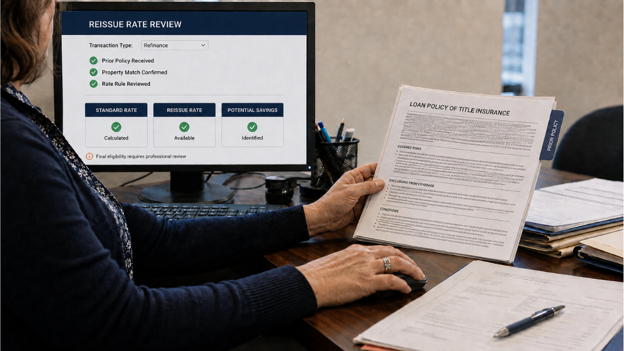
Refinance teams spend enormous effort managing rate, disclosures, conditions and closing costs. Yet one potential savings opportunity is often considered only after the title order has already moved into production: whether a prior title policy makes the transaction eligible for a reduced premium.
A title insurance reissue rate can lower the applicable title premium when the transaction, prior policy and jurisdiction satisfy the governing requirements. It is not a universal discount, and it should never be quoted from memory. Eligibility, documentation, time limits and calculations vary by state, underwriter, product and transaction structure.
The operational lesson is simple. Ask early, verify carefully and document the result.
What a Reissue Rate Actually Recognizes
Title insurance pricing is tied to the current policy being issued, but a prior policy may establish that qualifying title work and coverage existed for the property. Under applicable rate rules, that history may support a reduced premium for a new owner’s or lender’s policy.
In a refinance, the borrower may have an existing lender’s policy from a prior loan or an owner’s policy from the acquisition. The mere existence of an old closing statement is not always sufficient. The title provider may need the prior policy itself, information about the insured amount, the effective date and confirmation that the property and parties fit the applicable rule.
That is why the title insurance reissue rate belongs in the intake workflow, not in a last-minute negotiation at the closing table.
Why Lenders Should Care
Title premiums are one component of the borrower’s closing costs. When a reduced rate legitimately applies, identifying it early can improve the accuracy of cost estimates and reduce the likelihood of late revisions. It can also demonstrate that the lender and title provider are paying attention to the borrower’s entire transaction, not merely processing documents.
For a mortgage professional, the benefits may include:
- More accurate early conversations about title charges
- Fewer surprises when the final numbers are prepared
- A lower eligible premium where the governing rules permit it
- Better coordination between production, disclosure and closing teams
- A repeatable savings review across refinance pipelines
The benefit is not achieved by promising a discount on every order. It is achieved by building a reliable eligibility check into every appropriate order.
The Intake Questions That Create Savings
The best reissue process begins before the title search. Order forms and lender workflows should ask whether the borrower has a prior owner’s or lender’s title policy. They should also explain where the document may be found and how to provide it securely.
Useful intake information includes:
- The prior policy or a complete copy of the available title package
- Policy number, insurer and effective date
- Prior insured amount
- Property address and legal description
- Current ownership and vesting
- Existing loan information
- Proposed loan amount and transaction type
- Any change in the land being insured
If the borrower cannot locate the policy, the title provider may be able to research prior-file information, depending on the transaction and available records. That possibility should be investigated, not assumed.
A Disciplined Reissue-Rate Workflow
Step 1: Screen the Order
Identify refinances, recent purchases and other transactions that may qualify under the relevant rate rules. The screen should trigger a documentation request without telling the borrower that eligibility has already been established.
Step 2: Retrieve and Match the Prior Policy
Confirm that the prior document is an actual title insurance policy and that it relates to the correct property. Compare the legal description, insured parties, effective date and amount. Address discrepancies before calculating a premium.
Step 3: Apply the Governing Rule
The title provider should determine which filed rate, promulgated rate, manual or underwriter instruction governs the transaction. Some jurisdictions use specific eligibility periods or tiers. Others distinguish among original, refinance, reissue or substitution-loan rates. A title insurance reissue rate should be calculated only after the correct rule is identified.
Step 4: Document the Basis
Retain the prior policy or other required evidence, the applicable calculation and the reason the rate was used. Clear documentation supports consistent treatment, quality control and later file review.
Step 5: Communicate the Result
Tell the lender whether the rate applies, what information remains outstanding and whether a change in loan amount or structure could affect the calculation. Early communication allows the lender to coordinate disclosures and borrower expectations.
Common Reasons Savings Are Missed
The Question Is Asked Too Late
If the title team requests the prior policy after the commitment is delivered or shortly before closing, the borrower may not have time to find it. The lender may already have disclosed charges based on another assumption.
The Prior Document Is Incomplete
A settlement statement, invoice or commitment may show that a prior transaction occurred, but it may not satisfy the documentation requirements for the reduced rate. Teams should identify exactly what evidence is needed in the applicable jurisdiction.
The Property or Vesting Changed
Additional land, a different legal description, a new ownership structure or another material change may affect eligibility. These facts require review rather than a blanket yes or no.
Teams Use One Rule Nationwide
Multistate lenders cannot assume that a process used in one state transfers to another. Rate rules and required notices differ. The workflow can be standardized; the legal and underwriting analysis cannot.
No One Owns the Review
When the lender assumes the title company will ask and the title company assumes the borrower will volunteer the policy, the savings opportunity disappears between functions. Assign a responsible role and a due date.
Reissue Rates Are Also a Compliance Discipline
A reduced premium should be offered when the transaction qualifies under the governing requirements, not merely when a customer knows to demand it. Consistent screening supports fair treatment and reduces the risk that similarly situated borrowers receive different outcomes because one had a more experienced loan officer.
At the same time, marketing language must be precise. A title insurance reissue rate is not guaranteed savings. The amount cannot be stated responsibly without transaction details and the applicable jurisdictional rules. Title providers should avoid national percentage claims unless they can substantiate exactly where and when those figures apply.
Lenders should also coordinate the timing and disclosure of title charges with their own compliance teams. The title provider supplies transaction-specific information, but the lender remains responsible for its disclosure obligations.
How to Measure a Reissue Program
An enterprise refinance operation should treat reissue review as a measurable process. Useful indicators include:
- Percentage of eligible transaction types screened
- Percentage of orders with a prior-policy request sent at intake
- Prior policies received before commitment delivery
- Confirmed eligibility rate by jurisdiction and product
- Time from document receipt to rate determination
- Number and cause of premium revisions
- Documented borrower savings where permitted
- Exceptions identified during quality review
These measures show whether the program is consistently identifying legitimate opportunities rather than relying on individual memory.
Savings Begin With the First Conversation
The right time to discuss the title insurance reissue rate is when the order is opened. Early screening gives the borrower time to locate prior documents, gives the title professional time to apply the correct rule and gives the lender time to communicate accurate costs.
Title X incorporates reissue-rate review into its refinance workflow, subject to the transaction, jurisdiction and applicable underwriting requirements. If your lending team wants a faster, more disciplined process for identifying potential title savings, speak with a Title X closing specialist about your refinance markets and production needs.