
6-HOUR AVERAGE TITLE COMMITMENT DELIVERY • FIRST AMERICAN • WESTCOR
AFFILIATED BUSINESS ARRANGEMENTS
An affiliated business arrangement must be more than an ownership document and a source of referrals. It must be a genuine business with proper capitalization, independent operations, meaningful services, documented controls, and a clear commitment to consumer choice.
Title X develops and operates title agency joint ventures within the requirements of RESPA Section 8 and Regulation X. From the initial feasibility review through licensing, launch, training, and continuing oversight, we provide the experience and infrastructure required to establish a credible and sustainable AFBA.
OWNERSHIP
OPERATIONAL PRACTICE
CONTINUING CONTROLS
RESPA COMPLIANCE
Section 8 of RESPA prohibits the payment or acceptance of fees, kickbacks, or other things of value in exchange for the referral of settlement service business involving a federally related mortgage loan.
It also prohibits the splitting of settlement service charges unless the payment is for services actually performed.
An AFBA is not a method for compensating referrals. It is an affiliated relationship between legitimate business owners and a settlement service provider. The arrangement must be structured and operated in accordance with RESPA Section 8, Regulation X, and all applicable state requirements.
Title X builds compliance into the ownership structure, referral process, disclosure procedure, financial controls, operations, and continuing governance of every venture.
RESPA SECTION 8
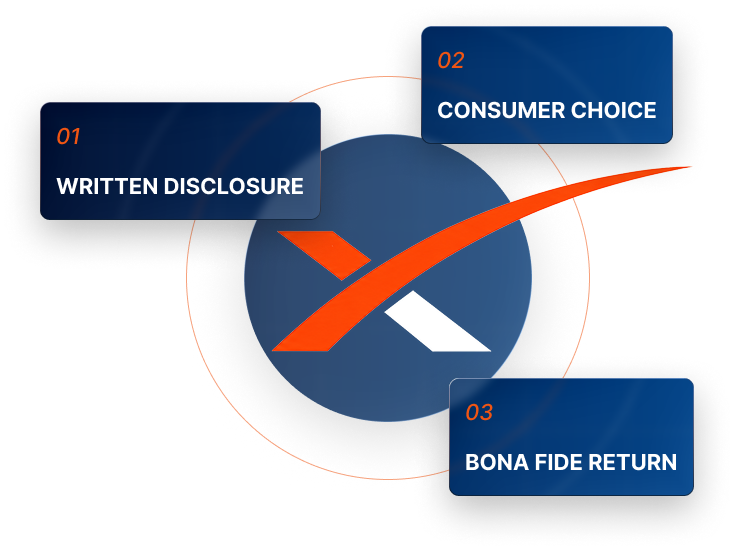
The person making the referral must provide the consumer with a separate written disclosure describing the affiliated relationship.
The disclosure must explain the ownership or financial interest between the referring party and the settlement service provider. It must also provide an estimated charge or range of charges for the services offered by the affiliated provider.
The disclosure must generally be delivered no later than the time of the referral. Title X develops a formal process for delivery, acknowledgment, tracking, exception reporting, and record retention.
The consumer must generally remain free to select another settlement service provider.
The referring party cannot condition the transaction, service, opportunity, or benefit on the consumer choosing the affiliated title company, except in the limited circumstances recognized by applicable law.
Consumer choice must exist in practice. It should be reflected in the disclosure, referral language, marketing materials, training, communications, and conduct of every person involved in the referral process.
A legitimate owner may receive a bona fide return on an ownership interest.
That return cannot be calculated, increased, reduced, or allocated according to the number, value, or anticipated volume of referrals made by an owner.
Distributions should reflect legitimate ownership, actual capital investment, financial performance, and the governing documents of the business. The economics of the venture cannot function as disguised compensation for referrals.
SUBSTANCE OVER FORM
A properly developed AFBA should demonstrate:
01
02
03
04
05
06
07
08
09
10
11
12
The most important question is not whether the correct documents were signed. The most important question is whether the venture operates consistently with those documents every day.
The Title X Joint Venture Process
From initial strategy through formation, licensing, compliance, and launch, Title X provides a structured, end-to-end process for building and operating compliant title joint ventures.
We begin by evaluating the proposed partners, target market, anticipated transaction profile, ownership expectations, capital requirements, licensing obligations, and operational needs. The objective is to determine whether the opportunity can support a compliant, genuine, and sustainable title business.
We develop the ownership and governance framework for the new business, establishing how the partners will capitalize, manage, and participate in the enterprise while maintaining a structure designed around applicable AfBA and RESPA requirements.
Ownership percentages
Capital contributions
Governance and voting rights
Ownership-based distributions
Once the structure is approved, we coordinate formation of the title agency and establish the organizational, financial, and administrative foundation required for the business to operate.
Entity formation
Operating and organizational agreements
EIN and banking setup
Initial capitalization
We coordinate the licenses, individual qualifications, underwriter appointments, and related approvals required for the agency to conduct title insurance business in its intended markets.
Agency licensing
Individual licensing and designations
Underwriter appointments
Insurance and bonding requirements
We establish a standardized disclosure process designed to clearly communicate the affiliated relationship, ownership interest, anticipated charges, and the consumer’s freedom to select other settlement service providers.
Disclosure timing
Ownership and financial-interest disclosure
Estimated charges or fee ranges
Consumer choice and recordkeeping
We develop referral policies and train participating owners and personnel on compliant referral practices, disclosure requirements, prohibited compensation, and appropriate communications with consumers.
RESPA and AfBA training
No required-use procedures
No payment for referrals
Documentation and compliance controls
We build the operational infrastructure necessary for the title agency to function as a professional, scalable business, including people, technology, workflows, financial controls, and compliance procedures.
Staffing and responsibilities
Technology and workflows
Escrow and accounting controls
Compliance and reporting
Before launch, we conduct a comprehensive readiness review to confirm that licensing, underwriter approvals, disclosures, technology, workflows, financial controls, and team training are complete and functioning properly.
Compliance readiness review
End-to-end workflow testing
Team and system readiness
Final launch approval
CONTINUING AFBA OVERSIGHT
An AFBA requires active governance and continuing oversight. Title X supports a structured review process that may include:
01
02
03
04
05
06
07
08
09
10
11
12
13
14
Documents provided under the applicable Regulation X provisions must generally be retained for five years after execution.
FREQUENTLY ASKED QUESTIONS
Clear answers for partners evaluating the structure, operation, and continuing responsibilities of an affiliated title business.
BUILD WITH CONFIDENCE
Title X provides the structure, operational discipline, and continuing oversight required to transform a qualified AFBA opportunity into a functioning title agency.
We build genuine businesses designed to serve consumers, support partners, and operate within the requirements of RESPA Section 8.